
Mount Allison University
Mount Allison University
| Institution: |  |
| Location: |
Sackville, N.B. , Canada
|
| Contact: | Mr. Creelman, C.P.P. Purchasing Manager |
| Laboratory: | |
| Species: | Small-bodied fish (Killifish, Sticklebacks) and large-bodied fish (mostly Trout and Salmon). |
| Habitats: | Fresh water, Seawater ; |
| Temperature: | 5° to 35° C; |
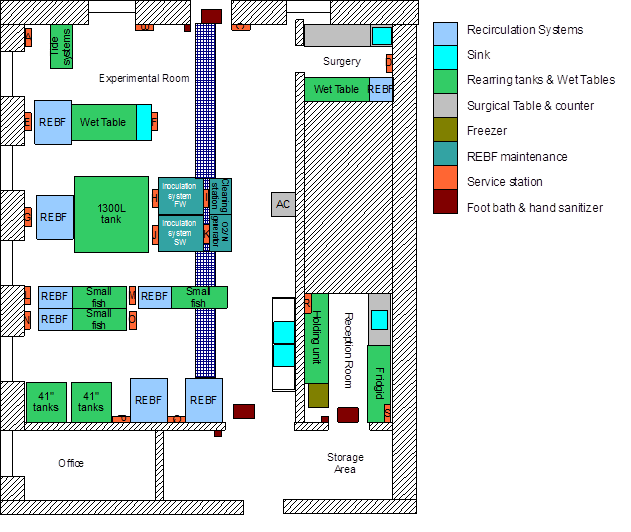
| Description: | A few racks of aquaria are needed for experiments with small fish-bodied fish (killifish, sticklebacks). One of the 3 units will be capable of creating hypoxic conditions and inducing thermal shock. One specialized unit for small fish will provide tide simulation.
Three units will be used for experiments with large-bodied fish (mostly trout, salmon). Two units will use four existing square 300-L tanks, in two sets of 2 superposed tanks. The third unit is a wet table that will mostly be used for cannulated fish. For the moment, only one of the two units of 300-L tanks will feature oxygen control for hypoxia and temperature shock capacity at a time, but the piping connecting the two tank modules to the two treatment modules will be made to allow quickly swapping the two. In the future, the other treatment module can be upgraded. An existing 1300-L tank will be used for holding large fish. Two raceway-style units will be used to hold various fish. All these holding units will offer temperature control to accommodate different species, but without oxygen control for neither hypoxic conditions nor temperature shock capacity. |
| Water recirculation level: | 99.7% (1 water exchange/5 to 6 days); |
| Work done: |
|
Mount Allison University
Mount Allison University – Introduction
Dr. Suzie Currie is interested in completely renovating his actual lab space and moving to recirculating systems for both fresh and saltwater, in order to precisely control the experimental conditions. The purpose of this paper is to provide recommendations which will enable the Dr. Suzie Currie’s Aquatic Research Lab to become a pleasant and flexible working environment and a reference in the field for its state-of-the-art design and multi functionality. Dr. Currie’s field of interest is fish physiology and many experimental needs depend on tight control of temperature, oxygen and salinity.
The assortment of experimental units will support a wide range of experimental conditions for just about any species, through the monitoring or control of dissolved oxygen, temperature, pH, conductivity, photoperiod, flow, etc.
The use of advanced aquatic units featuring water recycling units will allow for precise temperature control into a wide temperature range, which is not possible currently, with conventional units. It will also allow the control of dissolved oxygen to re-create hypoxic conditions. These units will also make a much better use of the available water and electrical resources while maintaining optimal, stable living conditions.
Mount Allison University – Methodology and needs assessment
The scope of the research carried out by Dr. Suzie Currie was revised in detail by way of questionnaires, meetings and private interviews. Further, an analysis of existing aquatic facilities was undertaken. We collected information from our visit at the Aqualab in September 2008. Dr. Suzie Currie published several documents explaining her experimental objectives, needs, and constraints.
Through this process as consultant, we aimed at gaining a deep understanding of the experimental protocols developed by the researchers, and adjust our recommendations accordingly. For instance, the species of fish being used, their size, and their level of crowding provided valuable information on the types of systems required and holding tank volumes.
It was important to distinguish environmental from biological variables applied during the experimental processes. The number of environmental variables applied simultaneously during experiments such as water temperature, velocity of current, or concentration of a contaminant, allowed for an estimation of the minimum number of independent units that were required. Biological variables such as the size of fish, their origin, level of infection, and the number of replicates, provided a good indication of the number of tanks per system to recommend. We were also invited to respond to particular demands such as: control of the photoperiod, creation of conditions of hypoxia and thermal shock.
We regarded as highest priority to meet the challenging criteria of flexibility, ease of maintenance and reliability. We were most concerned that the Aquatic Research Facility complies with the requirements of the Canadian Council on Animal Care (CCAC), as detailed in the document Guidelines on: the care and use of fish in research, teaching and testing.
Mount Allison University – Quick summary of the needs
In summary of the needs expressed by Dr. Currie, behavioral and physiological studies will be performed with both small-bodied fish (Killifish, Sticklebacks) and large-bodied fish (mostly Trout and Salmon). Experimental conditions will include different temperatures (including thermal shocks), salinities, and oxygen levels (both chronic and acute hypoxic conditions). In addition, some experiments on small fish will be done at different contaminant concentrations or with varying water level for tide simulation. Some experiments with large-bodied fish will involve cannulated animals, for which a wet table is required. Another wet table is almost necessary in the surgery room