

Biofilter Inoculation Station (BIS)
An easy-to-use commercial-scale chemostat for nitrification
A Biofilter-Inoculation Station (BIS) is a novel automated system that grows nitrifying bacteria on biofilter media.
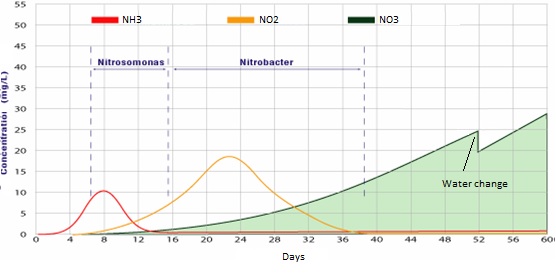
The nitrification process consists of transforming ammonia into nitrite and into non-toxic nitrate. It is part of the natural nitrogen bio-degradation cycle in soils, lakes and ocean. Nitrifying bacteria, a slow growing group of bacteria, require oxygen and extract their growth energy from inorganic nitrogen (NH4, NO2). Since they do not feed on organic matter, which provides so much more energy, they can be easily overgrown by bacteria that do (heterotrophic).
The Biofilter Inoculation Station creates the best possible environment for these slow-growing bacteria.
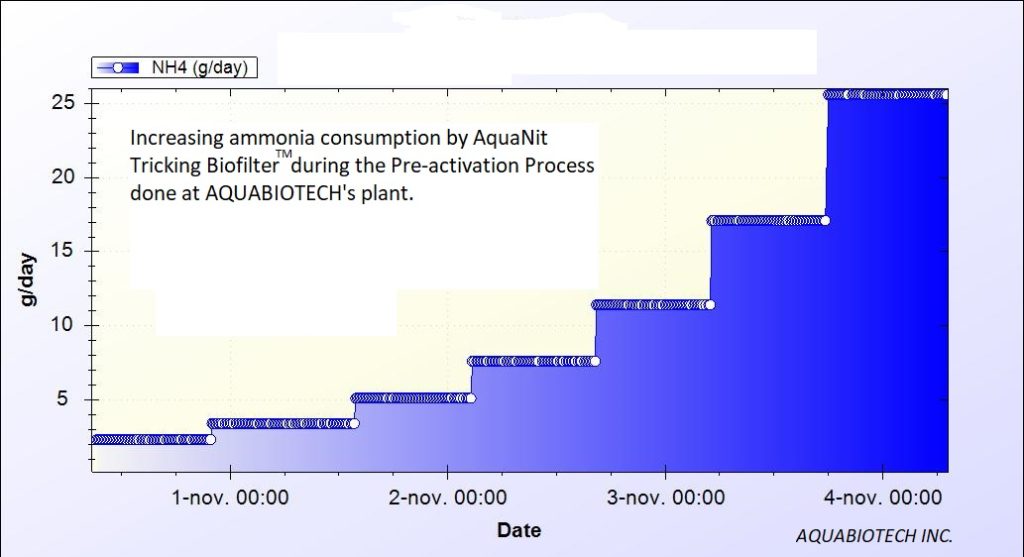
A light biofiltration media, packed into movable mesh bags, is set into a BIS where it is fed with increasing amounts of ammonia. Once coated with an active nitrifying population, the bag is simply removed from the BIS and inserted into the biofilter of a given bio-filtration system. All AquaNit™ biofilter media from AQUABIOTECH INC. is likewise, light and movable.
This process prepares a biofilter to its planned ammonia load. The result is a truly performing biofilter, on time, with tremendous savings in maintenance time before loading. The need to feed the biofilter, dose ammonia/nitrite/nitrate daily, and adjust pH is completely eliminated.
For years, all our biofilters have been pre-activated at our factory before delivery to save our clients time and add peace-of-mind. Now, the automated process is made available!
A self-regulated process
The BIS was designed from the graduate work done by Hélène Drouin, AQUABIOTECH INC. co-founder, while doing her Ph.D. on nitrifying biofilter at Université Laval, CANADA. Now integrated into the Inoculo-Monitron™, and associated hardware, the bio-inoculation process is self-regulated. Water temperature, pH and water make-up are specifically adjusted to keep nitrifying bacteria under exponential growth conditions. Self-activated, the injection of ammonium growth solution and nutrients increases as the nitrifying population grows. When the daily ammonia consumption target is reached, the BIS falls into a Maintenance Mode.
The BIS is furnished with an air blower, providing these aerobic bacteria the necessary oxygen.
Applications
- Aquatic and marine laboratories operating in highly recycled water;
- Aquaculture RAS;
- Biofilters for lobster storage systems;
- Biofilters for industrial treatment of nitrogenous waste;
- Maintenance of nitrifying biofilters during winter or off season period
Laboratory and industrial scale models
Two models of biofilter inoculation stations are currently available, a smaller station for laboratories which can activate 1 cubic meter of biofilter media and a larger BIS for industrial scale projects.
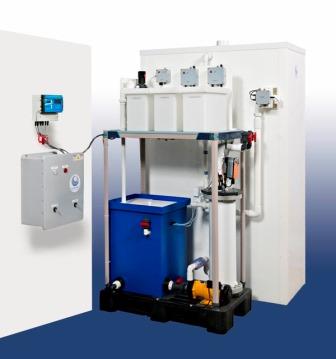
1. Biofilter Inoculation Station (BIS) for Laboratories
If you are interested in this equipment, contact us!
Adds bio-safety to an aquatic laboratory
With a BIS, we know exactly how much ammonia is oxidized daily by the biofilter media. Once it has proven itself ready for the future ammonia load, the biofilter bag(s) can be transferred into the biofilter of a given RAS. Fish or invertebrates can then be safely added to the system.
This process results in tremendous savings in technician time for dosing ammonia, adjusting pH and feeding the bacteria. The operator is confident that the biofilters are ready for the ammonia load excreted by the organisms, preventing initial ammonia spikes.
Not only does a BIS activate new biofiltration media, but it can also maintain it bio-active between experiments. For added bio-security, the used bio-filtration media can be discarded, preventing cross-contamination ,via the biofilter, between experiments.
Eight biofilter 100-L bags activated at a time
A standard BIS for wet labs can simultaneously inoculate eight AquaNit™ bio-filter bags – dimensions from 25 to 30 cm in diameter and 140 cm in height – or 32 x 1-L Siporax filter bags.
The wet lab unit is furnished with an air blower, providing these aerobic bacteria with the necessary oxygen.
The bio-inoculation unit requires a 115V, 60Hz electrical connection and a source of de-chlorinated fresh or seawater.
Three storage reservoir hold the liquids necessary for bio-inoculation process: the pH buffer solution; the growth medium; and the nutrients medium. These solutions are provided by Aquabiotech and the reservoirs are simply filled manually by the operator.


Industrial-scale biofilter Inoculation Station (BIS-8m3)
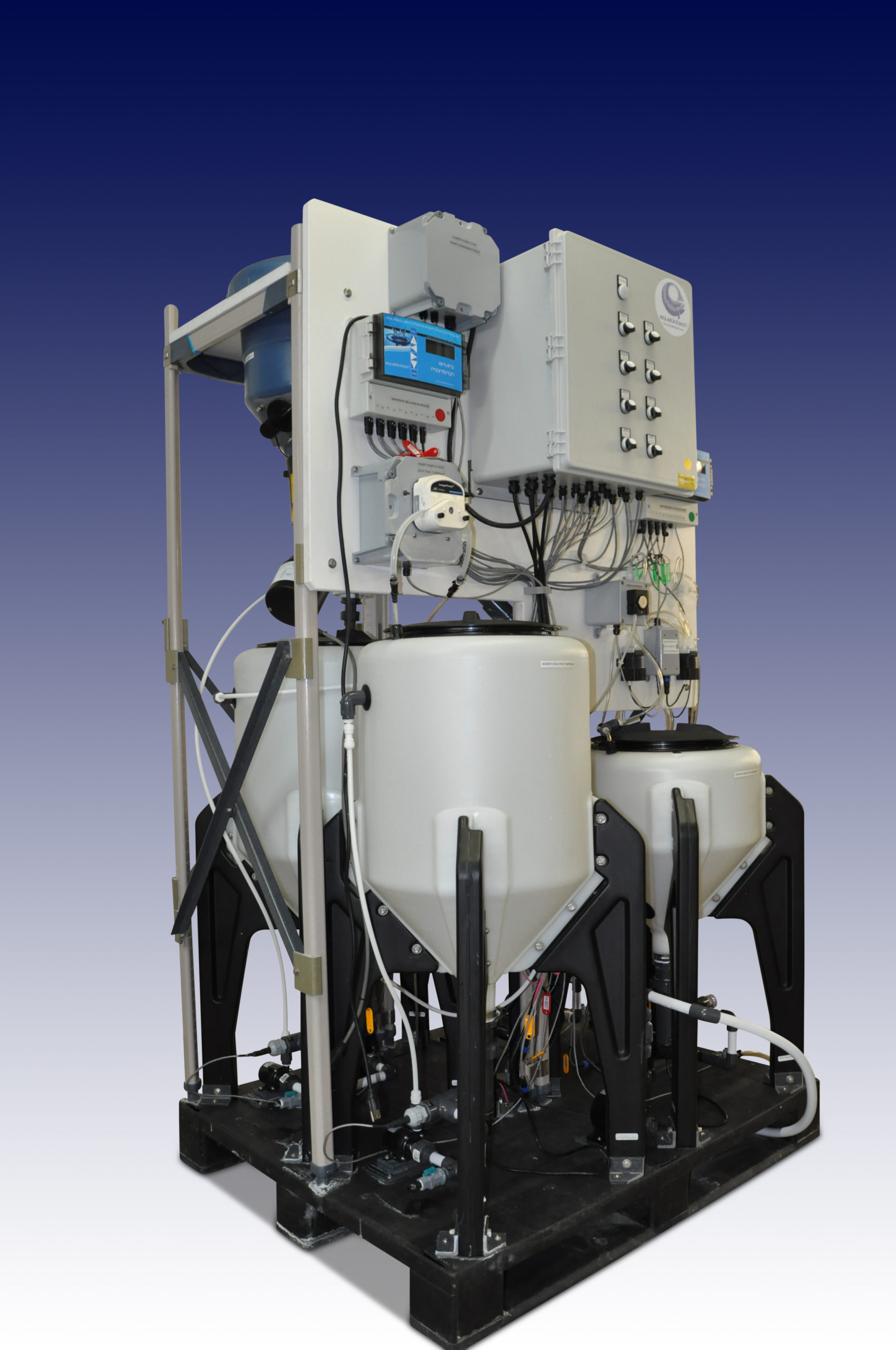
This outstanding BIS offers the same characteristics as the BIS-1m3 but with additions allowing to easily inoculate up to 8 m3 of the bacterial substrate.
Indeed, this model has also the ability to automatically prepare growth and pH control solutions. Simply fill the hoppers (capacity of 22 kg) with chemicals in the form of powder, so that the system starts the process of manufacturing aqueous solutions. Subsequently, the Inoculo-monitron will inject these aqueous solutions in increasing amounts in order to automatically inoculate the bacterial substrate.
This bio-inoculation unit requires a 115V, 60Hz electrical connection and a source of de-chlorinated fresh or sea water. It is furnished with three solution tanks which contain the liquids necessary for the process of bio-inoculation: the pH buffer solution; the growth medium; and the nutrients medium. This last tank is filled manually by the operator.
If you are interested in this equipment? Contact us!
Technical Details
The precise follow-up of pH in a BIS is important. pH measurement thus occurs into a water sampler that completely shunts any electrical interference, such errant electro-magnetic waves. A solenoid valve activates the circulation pump to collect an water sample at regular intervals and the pH level is displayed on the Inoculo-monitron.
- High-flow, low-pressure air from a blower flows through the BIS in a counter-current fashion for better gas transfer.
- The incubator lid is provided with a chimney trapping humidity from the air before it is expelled from the BIS. Condensation drains out by via a vinyl tube.
- The BIS is efficient at both CO2 degassing and oxygenation. The high air-to-water ratio and large contact area within the chemostat maintain the CO2 level below 15 mg/L and the water well oxygenated.
| Advantage | Suitability to Application |
|
|
|
|
|
|
|
|
|
|
|
|
|
|
The AquaNit™ Biofilter is designed to keep the biofilm thin and active for optimal nitrification. A thin biofilm favors the diffusion of CO2, ammonia, and oxygen. The flow rate across the bioreactor maintains a self-cleaning action via constant shearing of excess microbial biomass. Starting and stopping the flow in a biofilter increases local agitation and favours the sloughing off of excess biofilm that may have accumulated on some parts of the biofilter. Sloughing off is normal and useful.
The energy output from the oxidation of ammonia and nitrites is considerably less than that from organic compounds. As a result, the microorganisms have a very slow growth rate. Reproduction time in pure culture is 8-24 hours. In effluent water, it is 20 to 40 hours. Their numbers are rapidly exceeded by those of heterotrophic bacteria in the presence of organic matter. Some of the heterotrophic bacteria are known to double their numbers in as little time as half an hour. It is for this reason that we make sure that a sufficient population has been implanted in the Aquabiotech system biofilters before delivery. The proprietary method used for biofilter activation ensures a dynamic and efficient biofilter operation, even when it is connected to well-loaded fish tanks. Periodic additions of sustaining bacteria are not required.
After start-up, biologic filters can operate for several years without backwash. Depending, of course, on the use to which they are put, they may even improve with age as other microorganisms become implanted. We recommend the following elementary precautions in order to guarantee optimal performance.
- Do not disturb or wash the bacterial support.
- Maintain water pH above 7.0 at all times and alkalinity above 100 mg/L.
- Prevent the entry of organic matter in the biofilter in order to limit the growth of heterotrophs.
- The rate of exchange water (water make-up) must be less than the speed of reproduction of nitrifying in water (12 to 24 h).
As nitrifying bacteria do not survive a long time without organic pollution, it is important to provide inorganic nutrients when you remove all fishes. In this way, the biofilter remains active between two experiments.
Temporarily stopping the flow of water will not affect the bacterial biofilm, as the sump is full of water. Indeed, the humidity will keep the active biofilm for one to two weeks. A longer period requires re-inoculation of the biofilter when you restart the unit recirculation. Following an interruption of several months, allow at least 6 weeks for re-inoculating the biofilter.
The practice of good management is particularly important in the operation of a closed system. A biofilter is similar to a living organism; an increase in feed rate may give rise to a temporary increase in TAN and nitrite, and it may take a few days for the bacteria to adapt to this new regime. It is, therefore, most important to keep a tight control on the rate of feed to the aquatic organisms. If supplementary biomass is introduced, it must be followed by increasing the feed rate gradually. The colder the water, the longer it will take for the biofilter to adapt to an increase in feed rate.
The optimal temperature for nitrifiers in a temperate climate is known to lie generally between 25 and 30°C. An immediate consequence of using cold-water recirculating systems is the reduced growth rate of nitrifiers and their lower oxidation rate. Regardless of temperature, the growth rate of nitrifiers living in a relatively “clean” environment remains significantly higher than nitrifiers in activated sludge. Point of interest to note: the available data also indicate that the bacterial biomass is less sensitive to variations in temperature than the cells in suspension.
On the other hand, it is known that half saturation constants (Ks) of nitrifiers decrease considerably with decreasing temperature. For example, the half-saturation constant (Ks) of Nitrobacter sp. goes from 2.67 at 25ºC to 0.30 at 10ºC. It is thus clear that low levels of ammonia and nitrite can be achieved more readily in cold water than in warm water systems.
Management practices are influenced by this phenomenon of reduced activity of nitrifiers in cold water. Our biofilter has been sized for a maximum 0.8-kg dry food per day at 15ºC or more. If the water is colder, it can be assumed that the feeding rate will be less than 0.5 kg to account for the reduced appetite of fish. If fish appetite is not reduced by cold water, you should watch the biofilter closely, for it is reasonable to assume that the nitrifying capacity of the biofilter will have decreased.
Frequent water flows stop and start in the biofilter causing biofilm sloughing. It is therefore important to minimize this fact. Under conditions of a continuous and heavy charge of biologic material, this kind of sloughing off can naturally occur every two or three months. It may result in a temporary increase in the turbidity of the water for a day or two. It is recommended to increase the proportion of water make-up to minimize the discomfort for aquatic organisms. A preventive treatment with chloramine is also suggested. To minimise this temporary turbidity, it is suggested to trigger this sloughing off by interrupting the flow through the biofilter for few seconds once a month. This action will prevent biofilm build up.
A biofilter may be stored for several months without problem. The nitrifying bacteria are able to survive for a considerable time with very little attention. We recommend to simply keep the lid shut in order to conserve the humidity of the media. The bacteria must be protected from direct sunlight and freezing. Before storing the biofilter, make sure the purge has been emptied and that only a thin layer of biofilm covers the media. In general practice the support would already be very clean and coated with a thin, grey, gelatinous deposit.
| Parameter
Wanted range |
Explanation |
|
|
|
|
|
|
|
|
|
|
|
|
Users of this Technology
The logo of research institutions or companies do not indicate an endorsement of our products. They give only an indication of the different projects carried out. Click on a logo to see the description of the project.