
Multi-Stressor Units
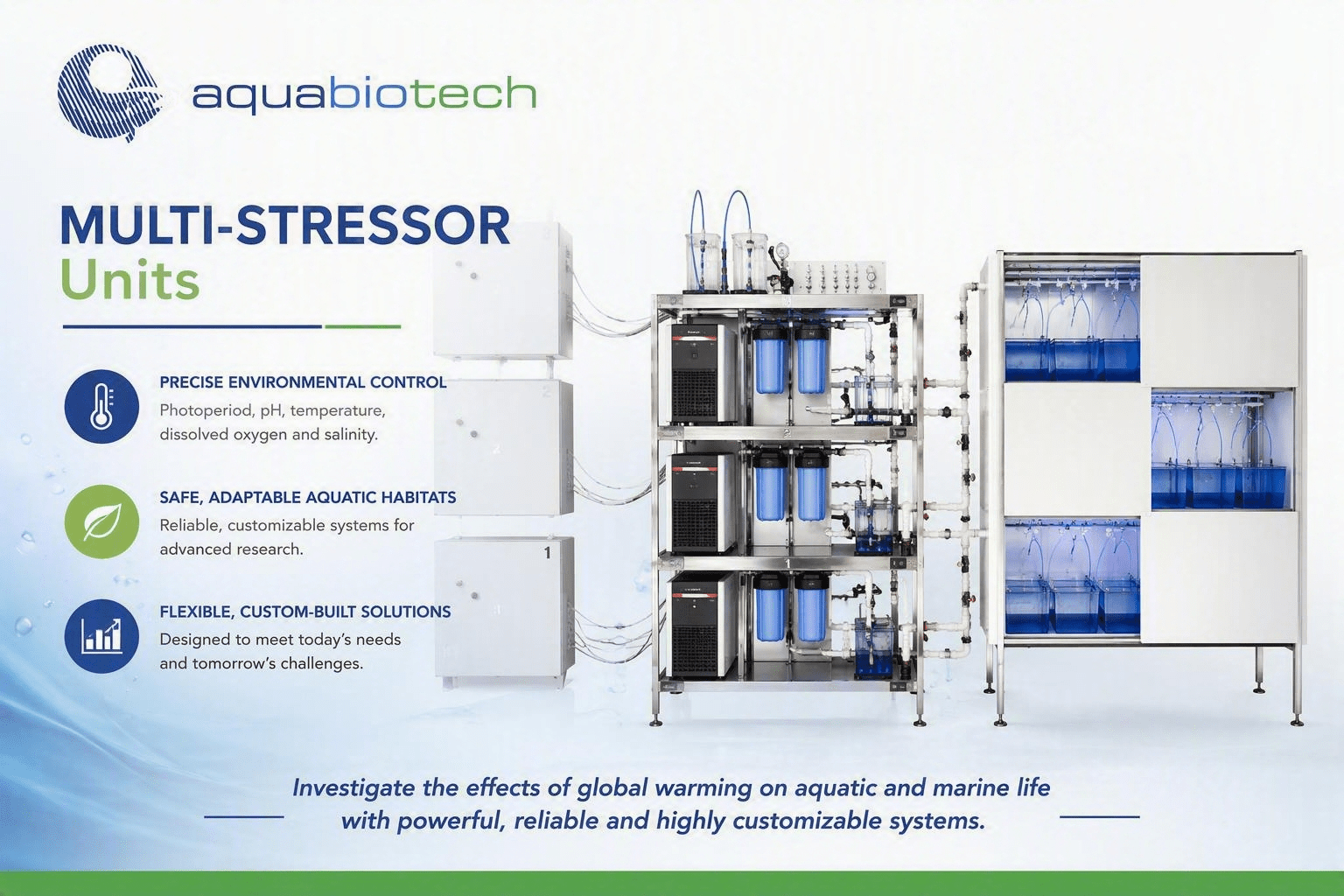
This unique line of safe, adaptable aquatic habitats creates
advanced environmental simulations.
Multi-Stressor Units are advanced aquatic research systems
designed for controlled environmental simulation in freshwater
and marine laboratory applications.
Researchers can independently control temperature, dissolved
oxygen, pH, salinity, and photoperiod to investigate the combined
effects of environmental variables under controlled laboratory
conditions.
These systems can recreate natural and simulated environmental
conditions while maintaining excellent repeatability between
experimental treatments.
When flexibility and reliability truly matter, Aquabiotech’s
innovative and highly customizable solutions are designed to meet
the requirements of modern aquatic research.
Common Research Applications
- Climate Change Research
- Aquatic Toxicology & Ecotoxicology
- Fish Physiology & Stress Response Studies
- Marine Environmental Simulation
- Freshwater Ecology Research
- Behaviour & Reproduction Studies
- Hypoxia & Dissolved Oxygen Research
- Salinity Tolerance Studies
- Photoperiod & Circadian Rhythm Research
- Environmental Monitoring & Impact Assessment
Modes of Control
Passive Control
Passive control is done without the use of probes or electronic control. Maintaining pH via the dissolution of calcium rocks is an example of passive control.
Static Control
Static control implies a stable set point, actively maintained via a probe and electronic system.
The parameter reaches a set point at its maximum rate and automatically remains at that set point via constant monitoring.

Dynamic Control
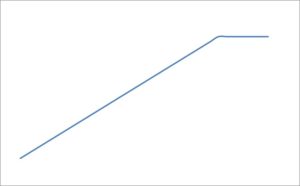
The parameter drops or rises at a given rate (e.g. 1.0°C/h), then stabilizes on a plateau.
To set dynamic mode, the operator enters:
- Desired set point
- Desired rate (e.g. 1.0°C/hour)
Cyclic Control
The parameter drops or rises and stabilizes on a plateau for a given period of time. After this period, the parameter automatically increases or decreases at the same rate to reach a second plateau. The cycle then repeats.
To configure cyclic fluctuation, the operator enters:
- First level
- Time to reach and maintain that level
- Second level
- Time to reach and maintain that level
Dynamic control over the rise and drop phases can also be incorporated by specifying a rate (e.g. 1.0°C/hour).

Individual Parameters
A Multi-Stressor unit can actively control several parameters simultaneously. Generally, when one parameter is going through fluctuations, the other parameters are kept stable (static).
For instance, the natural photoperiod of the northern hemisphere can be simulated while pH is kept at 7.6, dissolved oxygen at 70% saturation, and temperature fluctuating in cycles between 5 and 7°C in 24-hour periods.
Water Parameter Mix
Due to chemical or gas interferences, some parameters cannot be precisely controlled simultaneously. The table below illustrates the suitable parameter combinations.

Dissolved Oxygen
The level of dissolved oxygen can fluctuate between hypoxia, normoxia and hyperoxia in a Multi-Stressor unit.
Hypoxia and hyperoxia conditions are created with a mix of nitrogen gas, oxygen gas and air. The purity of nitrogen plays an important role in the level of hypoxia obtained and the rate of drop.
Static control:
Precision ±0.1 mg/L. Water 100% recycled.
Dynamic control:
Precision ±0.1 mg/L. Water 100% recycled.
Cyclic fluctuations:
Precision ±0.1 mg/L. Water 100% recycled.
Seasonal cyclic fluctuations can be obtained. The minimum and maximum levels may be adjusted every 1–3 weeks to simulate seasonal changes.

Water Temperature
Static, dynamic and cyclic control of water temperature (±0.3°C).
- Salinity-resistant temperature probe
- Quiet chilling compressor with titanium heat exchanger
- Water heater and controls
- Insulated units: 4–35°C (room temperature 20°C)
- Non-insulated units: 15–35°C (room temperature 20°C)
For temperatures ranging from 4–35°C, racks are enclosed with insulated panels, reducing chilling requirements, operating costs and condensation.
The covered habitat also facilitates photoperiod control with light ramping. Colder temperatures are available.

Salinity
Currently, only static salinity control is offered.
Salinity is managed through the controlled inflow of concentrated seawater (for example 50 PSU) and freshwater.

pH
pH control can be static or dynamic.
pH may be lowered using controlled injection of CO2 gas or a weak acid in freshwater or seawater.
pH may be increased through aeration or by adding a weak base. Aeration alone is sufficient in many freshwater and seawater applications.
During nitrification, pH gradually decreases due to the production of H+ ions. The system can automatically add diluted base to maintain the desired set point.

Photoperiod
Reduces light stress and allows for complete photoperiod manipulation.
Photoperiod control is often integrated to better mimic natural environmental conditions.
LED lighting above each shelf can modulate light intensity, recreating dawn, dusk and natural circadian rhythms.
The photoperiod cycles are controlled by the Monitron
Light Dimming:
Sunrise and sunset are simulated through gradual light ramping, reducing stress associated with abrupt light changes.
Astral Cycle:
Natural day-length progression can be simulated from any geographic location and date.
Change Season Length:
Seasons can be compressed or expanded. For example, a year can be configured with a short winter followed by a long spring. Ideal for breeding studies.

Options
Many options are available for conducting a wide range of experimentation, making your Multi-Stressor Unit a flexible product to meet not only your current needs but also future requirements.
Larger Tanks
Large fish or large crustaceans may not fit into 9-L tanks. Some researchers have replaced their 9-L tanks with larger custom tanks (e.g. 20-30 L tanks).
The factory-built habitat flow rate and filtration system remain suitable for these larger tanks. Non-self-cleaning tanks may require periodic siphoning and increased filter maintenance.
Should you wish larger tanks incorporated into the system at delivery, simply let us know.
Tanks for Salmonids
Another option for large fish is to purchase one or more self-contained water recycling with biofiltration systems (REBF) of larger biomass capacity. Controls are integrated à la carte into the REBF system.
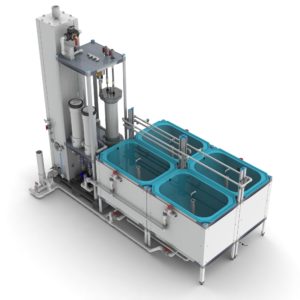
This can result in configurations such as systems equipped with four 70-L tanks.
Photoperiod Control
Insulated panels are optional when integrated photoperiod control is included and may be omitted in warmer water applications.
Our experience indicates insulation is generally not required when water temperature remains above 15°C and ambient air temperature remains below 25°C.
Photoperiod control is also available for larger tanks using LEDs mounted in opaque lids and controlled through the Enviro-Monitron.
Nitrogen Generators
To create hypoxic conditions down to 1.5 mg/L dissolved oxygen, nitrogen gas with a purity of at least 99% is recommended.
State-of-the-art membrane separation technology produces dry nitrogen up to 99% pure and automatically supplies the dissolved oxygen control system.
The generator can support up to three Multi-Stressor Units simultaneously.
Oxygen Generators
Some applications require 100% oxygen saturation or supersaturated water conditions.
In these cases, an oxygen generator may be supplied as an option. Oxygen cylinders may also be used.
Low Temperature
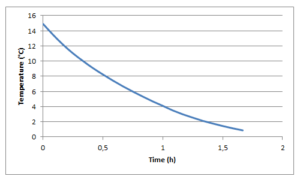
In this custom configuration, water temperature can be reduced to 0°C ± 0.3°C in brackish water.
Conditions include an ambient temperature of 20°C or less and salinity of at least 10 PSU.
A central glycol refrigeration system maintained at -4°C is used.
High Rate Temperature
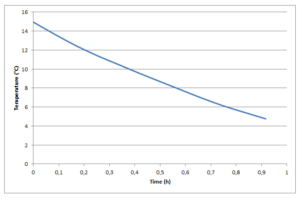
Aquabiotech also custom-builds glycol chilled systems capable of heating and cooling water at rates up to 10°C per hour.
Technical Details
Technical Details
Each Multi-Stressor unit is custom-built with high-quality materials and a specific mix of software and precision equipment for achieving your application.
Up to three Multi-Stressor units can be installed per rack. All systems are mounted on high-strength fiberglass and plastic stands with built-in Microban® antimicrobial protection.
This protection helps prevent bacteria, mold, mildew and fungi that can cause odors, stains and product degradation.

Components

CSA-Approved Control Panel
- NEMA 4X enclosure for humid environments
- Automatically starts the backup pump for the fish habitat
- Automatic on/off switch with overload protection for critical components
- Quick-plug IP68 connectors for each device
Water Recycling and Control Module
- Includes quiet pumps and a chiller
- Quality-selected water filtration equipment operating with a dedicated pump
- Precision hardware for each environmental control
- Biofilter pre-activated with live nitrifying bacteria before delivery
- Automatically controls the make-up water flow
Fish Habitat
- Operates with an independent water-recycling pump
- Insulation panels are standard for cold-water operation at 15°C or less, with independent photoperiod simulation
- Flow rate to the habitat is adjustable
Control Panel
Each Multi-Stressor unit is associated with an Enviro-Monitron™.
The Enviro-Monitron™ provides intelligence by converting data from probes into commands. The CSA-certified control panel dispatches these commands to the appropriate equipment.
Every control option is carefully programmed and tested. Some controls are optional, while others are included by default.
The standard Enviro-Monitron™ capabilities include:
- Automatic control of the make-up water inlet from 0–100% of total volume replacement per day
- Static, dynamic and cyclic temperature-control options
- Automatic startup of the backup pump following a flow interruption
- Fish-habitat alarm that helps maintain water flow to the rearing tanks following a pump failure
- Automatic interruption of heating and cooling following a flow interruption in the filtration module
Water Recycling and Control
Multi-Stressor systems are designed for closed-circuit operation. No more than 5–10% of the rearing-tank volume normally needs to be replaced each day.
Operating costs for heating, chilling and environmental control are therefore considerably reduced.
The water-renewal rate is automatic and adjustable.
The water-filtration module includes the stages required for closed-circuit operation:
- Pre-activated biofilter
- 20-micron solids filtration
- Carbonate stones for passive pH control
- Activated carbon
- Degassing
- Aeration
Multi-stressor systems can receive freshwater, seawater, diluted toxicant or distilled water.

Fish Habitat
All fish tanks within the same Multi-Stressor unit share the same water and are exposed to the same environmental and experimental conditions.
A compact rack can accommodate one to three Multi-Stressor units.
Rearing Tanks
The self-cleaning polycarbonate rearing tanks are available in 1-, 3- or 9-L formats and include a lid, baffle and screen.
A rapid water exchange carries away food particles and helps keep the tanks clean. It also helps maintain stable environmental parameters within each tank.
The flow rate to the rearing tanks can be adjusted by the operator.
A Multi-Stressor unit can contain:
- 6 × 9-L tanks
- 12 × 3-L tanks
- 14 × 1.5-L tanks
All tanks within and between units are interchangeable.
Food-Approved Shelving
The shelving is made of seawater-resistant plastic approved for direct contact with food and does not leach chemicals. The shelving incorporates Microban® antimicrobial and mold-resistant protection.
Rack Dimensions

Aquabiotech’s equipment comes with highly professional service.
Customer oriented, our sales team is dedicated to walking you
through each step in designing the right system for your needs.
Take advantage of our free quote preparation service
to facilitate access to government research funding.
Frequently Asked Questions
What is a Multi-Stressor Unit?
A Multi-Stressor Unit (MSU) is an aquatic research system designed
to simulate environmental conditions in freshwater and marine
laboratory applications. Researchers can precisely control multiple
environmental parameters while maintaining stable experimental
conditions for aquatic organisms.
Which environmental parameters can be controlled?
Multi-Stressor Units can be configured to control temperature,
dissolved oxygen, pH, salinity, and photoperiod. Multiple
parameters may be controlled simultaneously, allowing researchers
to investigate combined environmental stressors and ecosystem
responses.
What types of research applications are Multi-Stressor Units used for?
Multi-Stressor Units support a broad range of aquatic research
applications, including climate change studies, aquatic toxicology,
ecotoxicology, physiology, reproduction, behaviour, nutrition, and
environmental monitoring projects involving freshwater and marine
species.
Can Multi-Stressor Units simulate climate change scenarios?
Yes. The systems can reproduce environmental changes such as
temperature fluctuations, hypoxia, altered salinity, changing
photoperiods, and pH variation. Dynamic and cyclic control modes
allow researchers to model realistic environmental conditions and
long-term climate change scenarios.
Can the systems be customized for specific research programs?
Yes. Every system is built to the requirements of the research
program. Tank sizes, environmental control options, photoperiod
systems, life-support equipment, and overall system configuration
can be customized to suit the species, experimental protocol, and
facility requirements.
Users of this Technology
The logos of research institutions do not indicate an endorsement of our products. They give only an indication of the different projects carried out. Click on a logo to see the description of the project.